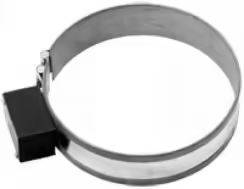
Description
Tanks requiring industrial tank heaters can utilize indirect heating with band heaters, or they can use direct heating that typically uses some form of immersion heating. Indirect Heating WATTCO Band heaters can be found in several types of dimensions, wattage, voltages and materials.
Industrial heating systems still use band heaters because these devices provide controlled heat distribution, which is essential for their operations. The design flexibility and system compatibility of these heaters enable their use in various operational environments.
What Are Band Heaters?
Mica band heaters are an inexpensive industrial heating solution that surrounds pipes and tubes that require external indirect heating. Pipe heating, drum heating, and barrel heating are normally used for oils, lubricants or any other circular applications.
Band heaters work by encasing cylindrical surfaces, which enables heat to move from the heater’s exterior to the interior material. The indirect heating method maintains constant temperature control by preventing direct contact between the material and heating elements, which creates a safer and more regulated operational environment.
Band heaters use electric heating elements (NiCr wire) to heat-up the external surface of drums or pipes for a gradual heat transfer. Band heating is an indirect form of industrial heating and offers safety when heating volatile and explosive substances as well as pipes or containers that cannot otherwise be heated using direct heating methods.
The design enables industries to handle sensitive materials through improved methods, which reduce risks from direct heating techniques. Controlled heat transfer systems provide operational consistency for processes that need uninterrupted thermal conditions throughout lengthy time frames.
Applications of Band Heaters
Industrial operations that need exact and steady external heat for cylindrical surfaces depend on band heaters as their primary heating solution. It achieves indirect heating, which produces a safe and effective temperature distribution for various applications.
- Pipe heating, drum heating, and barrel heating are normally used for oils, lubricants or any other circular applications.
- Plastic processing industries utilize the equipment to heat their barrels, molds, and extrusion machines.
- The chemical industry uses the technology to provide secure heating methods for its sensitive and reactive materials.
- Food processing facilities use the equipment to preserve the correct temperatures inside their containers and vessels.
- The equipment serves as a heating solution for both storage tanks and cylindrical equipment.
- The manufacturing and packaging operations need the equipment to maintain consistent temperature ranges during their processes.
- The technology functions in lubrication systems to maintain the proper thickness of the fluid throughout its operation.
Types of Band Heaters
Band heaters exist in multiple designs, which depend on the insulation type required, the temperature needs, and the industrial uses of the heaters. The different options available enable users to choose the most suitable solution that matches their particular operational requirements.
- The various types of band heaters available at WATTCO include mica-insulated band heaters and ceramic band heaters.
- Mica band heaters are designed for cost-effective and moderate temperature applications
- Ceramic band heaters are suitable for high-temperature operations with better heat retention
- Custom band heaters are available in different dimensions, wattage, and voltage options
- Heaters with built-in or optional temperature control systems for precision heating
- Heavy-duty variants designed for continuous industrial use
Advantages of Band Heaters
Band heaters continue to be a preferred choice because they show excellent efficiency and safe operation, and they provide effective heating for industrial systems. Their design supports both operational performance and the reliability of equipment.
- Band heating is an indirect form of industrial heating and offers safety when heating volatile and explosive substances, as well as pipes or containers that cannot otherwise be heated using direct heating methods.
- Provides uniform heat distribution across cylindrical and curved surfaces
- Supports applications which require both high watt densities and high operating temperatures
- Simple installation which works with all current industrial system installations.
- Affordable method to support ongoing heating needs in extensive operations.
- Proper insulation enables energy loss reduction through its combination with the system.
- Ensures controlled heating, improving process stability
Additional features of Band Heaters
Industrial band heaters can be made with NEMA 1 terminal boxes or NEMA 4 moisture-resistant terminal boxes that protect terminations and have the option of a thermostat or thermocouple digital temperature controllers to help control and regulate the applied heat.
Insulation is also required to help direct the heat to your application rather than experience heat loss, and slow heat-up time. Band heaters from WATTCO are the ideal solution for high watt densities and high operating temperature applications, especially for the plastics industry.
The heaters operate at industrial standards because their design meets safety requirements and efficiency needs. Band heaters continue to support industrial processes by offering reliable, uniform, and controlled heating solutions. Their ability to adapt across various industries while maintaining safety and efficiency makes them a practical choice for both standard and high-temperature applications.