Description
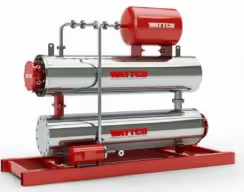
Circulation Heaters, also known as “in line heaters,” have uses in many applications. They can use steel, stainless steel, or titanium depending on the application. Lube oil and waste oil applications often use steel for circulation heaters. This is because it is fairly inexpensive compared to stainless steel counterpart.
Water circulation heaters use stainless steel because of its anti-corrosive qualities. In both applications, a pump flows the liquid, such as water or glycerol, through a closed pipe circuit. The liquid is reheated as it flows through the circulation heater.
Industrial circulation heaters come in a range of watt densities. Watt densities are specifically designed for the medium they will heat. The required wattage to heat the oil or water is highly correlated to the flow rate (in GPM).
- The fluid enters through the inlet closest to the flange heater.
- Heat gets applied to the fluid as it flows within a vessel chamber.
- The fluid exits the outlet nozzle or flange.
- It circulates throughout the piping circuit.
Insulation is often required for vessels to preserve the heat within the vessel. This results in efficient heat application, reducing unnecessary costs through heat loss. Electric circulation heaters can use digital thermocouple probes or RTDs. This allows them to maintain the oil or water at the preferred temperature. Many applications use liquids with low flash point. These require explosion-proof housing (NEMA 7) to avoid potential mishaps.
Shipping
Wattco uses its decades of experience shipping our industrial heaters worldwide. When shipping across borders, Wattco can handle all necessary import, customs and duties responsibilities to ensure that you receive your product on time and on spec. Wattco ships using all mediums upon request including: truck, train, container ship and by air freight when mission critical rush delivery is required.
Closed Loop Circulation Heaters
Circulation heaters are also used when heating closed loop systems. These can require high temperatures of up to 1000℉. These applications use large flange heating vessels that contain the gas and heating it efficiently. It requires low maintenance and provides excellent heat transfer.
Circulation Heaters for Oil & Gas Companies
Oil and Gas companies use circulation heaters in heating oils. Electric heaters assist them in modifying the viscosity levels of their heating oils. Crude oil enters an inlet of the vessel at a cool temperature. The circulation heater reheats the oil. The oil then exits the outlet at a temperature more convenient for flow as it travels from one end of the transport pipe to the other. Hydraulic fluid can also be heated using this electric heater for heat transfer purposes. It also provides freeze protection in cooler climates. This is crucial because winter temperatures can damage the fluid. Immersion heaters are widely used in a variety of industries. Particularly the oil and pipeline sector for several different purposes. These industrial heaters are specifically designed so that oil, water, viscous materials, gases, solvents and other different process mixtures can be heated in direct contact with each other. This allows the heat to be generated within a single enclosure or solution, and so hundred percent efficiency can be achieved. Get a quote for a circulation heater today. Also, check out our other high-quality industrial heating products in the WATTCO™portfolio.