Description
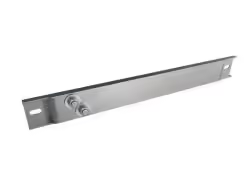
Strip heaters, or component heaters, provide an easy and efficient way of using surface area for effective heat transfer.
Industrial heating applications that need both direct surface heating and continuous temperature control still use strip heaters as their heating solution. The heating system provides an efficient solution for flat surfaces and small areas because of its straightforward design and dependable operational capabilities.
What Are Strip Heaters?
Steel strip heaters are an excellent industrial heating product. Using a temperature controller such as a mechanical thermostat makes them easy to control. Installing a bimetal thermostat on the heated surface is another cost-effective solution for strip heating.
Strip heaters function as flat heating elements which deliver heat through direct contact with surfaces. The method provides efficient heating, which distributes heat evenly, making the system suitable for applications that require constant surface temperature control. The temperature control system compatibility enables precise temperature control for all industrial operations.
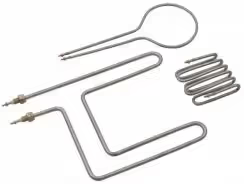
Strip heaters are composed of a heating element, a protective sleeve or sheath, and mounting hardware. Radiant heater strip heaters can have fins to maximize surface area and heat transfer to the air.
This not only aids in fast uniform distribution of heat, but also gives freedom for the applications where both surface heating and air heating may be required.
Applications of Strip Heaters
Industries use strip heaters because they provide direct surface heating, which delivers steady heat output with precise temperature control. The system can operate in different environments because of its built-in flexibility.
- Strip heaters can be clamped or bolted onto objects or solid surface contact heating over large areas. That makes them optimal for indoor applications where strip heating can be applied.
- Machinery employs this system to heat flat metal surfaces.
- Packaging equipment uses this system to create sealed packages through its forming functions.
- Ovens and heating chambers use this system to deliver consistent heat throughout the space.
- Manufacturing processes need this system to provide mold heaters which operate at specific temperature ranges.
- The HVAC system uses this system to distribute heat to specific areas within a building.
- Industrial equipment needs this system to control its surface temperatures.
Types of Strip Heaters
The strip heaters provide various designs, which include different design options and mounting methods, and show flexibility for industrial applications.
- The standard strip heaters function as basic heating elements for all surface heating needs.
- The radiant strip heaters with fins produce enhanced air heating power and improved heat distribution capabilities.
- The clamp-mounted strip heaters enable users to install and remove the heaters from their locations.
- The bolt-on strip heaters deliver a method for installing the system which keeps it firmly attached at all times.
- The custom strip heaters provide multiple design options, which include various size dimensions, wattage power ratings, and voltage electrical specifications.
Advantages of Strip Heaters
Strip heaters offer a cost-effective and efficient heating solution for applications requiring direct surface heating and consistent performance.
- Temperatures reach as high as 500℉ (260℃) and use the high-quality magnesium oxide found in tubular elements that allow effective heat transfer.
- Provides uniform heat distribution across flat surfaces
- Easy to install and integrate into existing systems
- Compatible with multiple temperature control options
- Durable construction ensures long operational life
- Cost-effective solution for heating small to medium areas
- Supports both surface and radiant heating applications
Installation and Features of Strip Heaters
Strip heaters include practical features that improve installation flexibility and operational efficiency across industrial setups.
- Mounting holes help mount process heaters securely on almost any surface, with the terminal extending from the sheath for easy electrical connections.
- Many users also request lead wires that extend from one end, which makes the installation more flexible, as the temperature control panel is easily adaptable to this configuration.
Strip heaters continue serving as a dependable heating solution by offering efficient surface heating, ease of installation, and cost-effective performance. The technology supports different industrial requirements using its capacity to create uniform heat distribution for multiple operational settings.