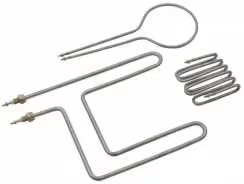
Description
What Are Tubular Heaters?
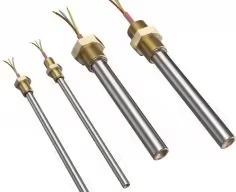
Tubular heaters are typically made using steel, stainless steel, Incoloy, inconel or titanium alloys. Tubular heating elements are often regarded as the foundation of all heating elements. These heating elements have a strong outer sheath to help protect the process heater from physical stress and uses high quality alloys to allow efficient heat transfer from resistance coil to your heating medium.
Tubular heaters function as cylindrical heating elements which provide thermal energy through conduction, convection, and radiation methods according to specific usage requirements. The system operates through its durable design, which maintains operational efficiency under extreme working conditions, while its material composition enables effective heat transfer between various substances.
Applications of Tubular Heaters
Tubular heaters serve multiple industrial sectors which demand precise and continuous heating of liquids and gases and solid materials. The equipment’s adaptable design permits operation in various environmental conditions while supporting multiple heating techniques.
- Depending on their rating, sheath and shape, WATTCO™ electric tubular heaters are used in a variety of industrial heating applications (conduction, convection, radiation heating) that require process temperatures of up to 750°C (1 382°F) to heat liquids, gases and solids.
- Functions as an immersion heater which heats liquids inside tanks and vessels.
- Operates as an air heating solution which supports HVAC equipment functions.
- Provides heating functions for ovens, dryers, and industrial furnaces.
- Provides heating capabilities which process industries use for their gas applications.
- Applied in mold heating and metal processing
- Used in chemical and food processing industries for controlled heating
Types of Tubular Heaters
Tubular heaters are available in various configurations based on application requirements, material selection, and design flexibility.
- The standard heating applications require straight tubular heaters.
- Compact installations require U-shaped or bent tubular heaters.
- Flanged tubular heaters provide immersion heating functions for tank applications.
- The custom-shaped heaters serve specific industrial functions through their design.
- The heaters feature various sheath materials which match different environmental conditions.
Advantages of Tubular Heaters
Tubular heaters provide an effective and flexible heating system which is usable across different industrial sectors. The design of the system enables it to maintain its operational capability while achieving its intended performance results throughout its complete operational time.
- A variety of diameters are available to adjust watt densities in your application and to design your industrial heating product for best performance and long life
- Provides various options for customers to create their desired product through customized shape and size selection
- Supports multiple heating methods, including conduction, convection, and radiation
- Durable outer sheath protects against physical and environmental stress
- Efficient heat transfer ensures energy-saving performance
- Operates in all industrial sectors which require high-temperature performance
- Easy to install and integrate into different systems.
Additional Features of Tubular Heaters
Tubular heaters include several design features that enhance performance, installation ease, and long-term reliability.
- Standard and custom made terminal pins allow for easy installation and maintenance.
- Wattco uses high quality magnesium oxide to allow for efficient heat transfer from resistive coil to your heating medium whether it is air, liquid or solid.
- Bending radiuses are designed with careful expertise to allow for optimal performance when meeting “form fit and function” within your application.